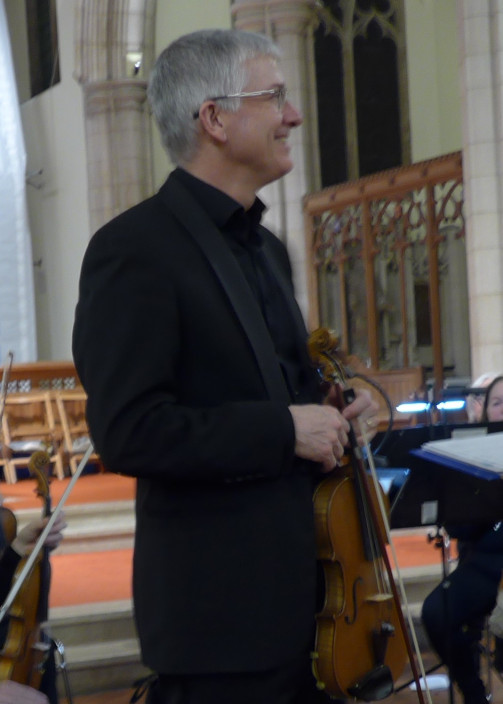
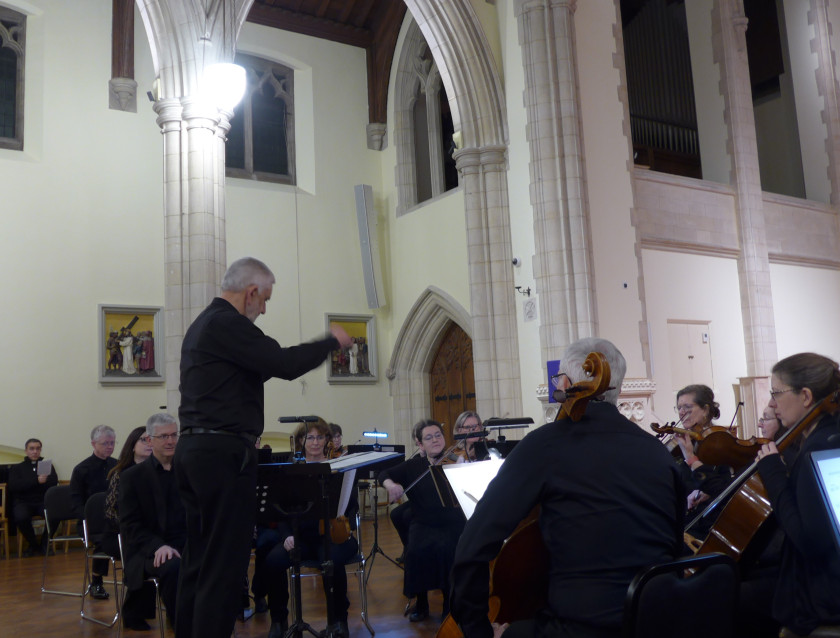
Centenary concert at St Peter’s Church at 7pm on Sunday 8th March 2026 in aid of Trinity Winchester
Review by Dr Lis Lewis
Winchester Camerata’s recent concert had two aims: firstly to celebrate the centenary of St Peter’s Church and secondly to raise money for the Trinity Centre which provides services to a wide range of people, from the most chronically excluded rough sleepers, to care-givers on low incomes in the form of support with housing, employment or training. The concert took place at St Peter’s, an intrinsic part of Winchester’s rich religious life. It is a beautiful stone church set back from Jewry Street in its own grounds. The conductor, Andrew Moore has a long association with the church in his work as a priest.
The concert though, illustrates the implicit aims of Winchester Camerata’s concerts – to give wonderful concerts of the string repertoire which are enjoyable for the audience, orchestra members and conductor alike. Last Sunday’s concert was no exception and featured several less well-known gems unearthed by the Andrew Moore, the conductor, in addition to a number of the conductor’s splendid arrangements for the ensemble. The concert celebrated the centenary in a kind of musical montage of the seasonal spiritual and liturgical celebrations occurring within the church and sketching in the related emotions.
Handel’s Air from the Water Music reminded us of the significance of water in the life of the church, and provided an apt introduction to the concert, followed by the fascinating Church Sonata no. 11 by Mozart. This was an opportunity for the different sections of the orchestra to shine as the themes were shared around, reminding that Mozart was a successful operatic composer, good a composing tunes. The next item, Byrd’s Ave Verum Corpus, although originally written for voices was performed here in Andrew’s arrangement for string orchestra. It was beautifully performed with the sacred-sounding opening passages senza vibrato. Interesting, but little-known pieces by Vivaldi and Bach followed: Vivaldi’s Sinfonia was in a dramatic vein making use of complex fugal techniques with many dissonances and pedal points all given atmosphere by the dramatic playing of the Camerata members.
The Meditation on the plainsong hymn Veni Creator Spiritus (Come, Creator Spirit) was composed by Andrew, and dates from his time working in Rome. Unusually, the conductor faced the audience as he intoned the hymn which preceded this imaginative performance. We heard the beautiful unresolved discords with a soaring, ethereal violin solo played by the leader, David Blunt. Continuing in a similar vein, Villette’s Hymne á la Vierge showed good ensemble between the players. It was powerful: a simple melodic line accompanied by luscious harmony, reminiscent of Poulenc, Fauré and Debussy. Grieg’s Wedding Day at Troldhaugen was a cheerful reminder of happy, festive events in church life. This is a lovely arrangement by Andrew showed the Camerata at it’s best, with a lovely rich sound, and spirited lively playing. Charpentier’s well-known Prelude to the Te Deum gave a rousing end to the first half of the concert.
After the interval, the orchestra performed Andrew’s composition Four Seasonal Sketches, completed in 2018. The four movements, Autumn, Winter, Spring and Summer showed off the orchestra’s wide range of tone colours and characterisation. Rich sonorities, recitative-like passages, ostinati and lively playing were on offer, with shades of Vaughan Williams, Elgar and Britten. The final item was Britten’s Simple Symphony was a Tour de Force, executed in an energetic mood. The second movement, Playful Pizzicato was lively and amusing and the Sentimental Sarabande featured some lovely violin playing while the final item of this notable concert was the fourth movement, a dramatically effective Frolicsome Finale.
Dr Lis Lewis
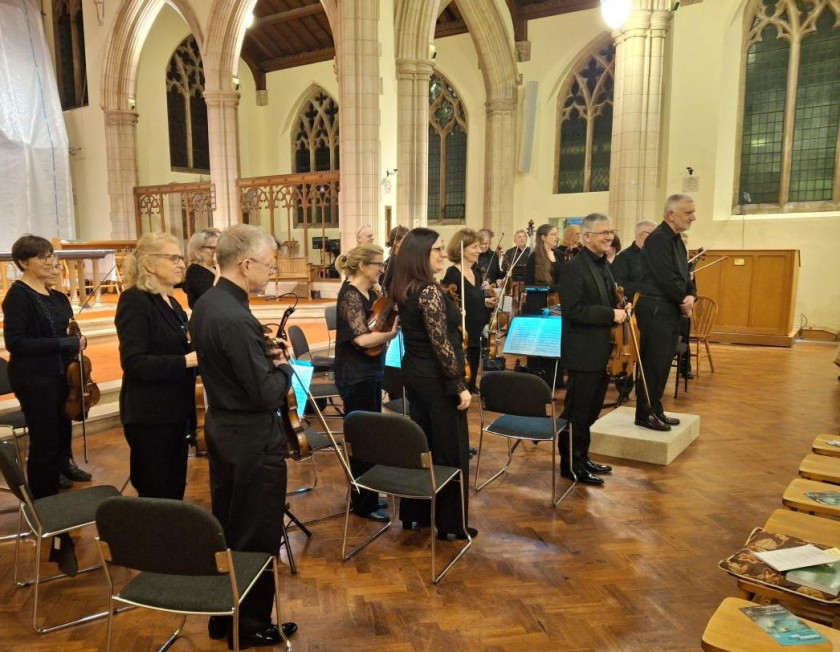
Image: Lisa Justice